
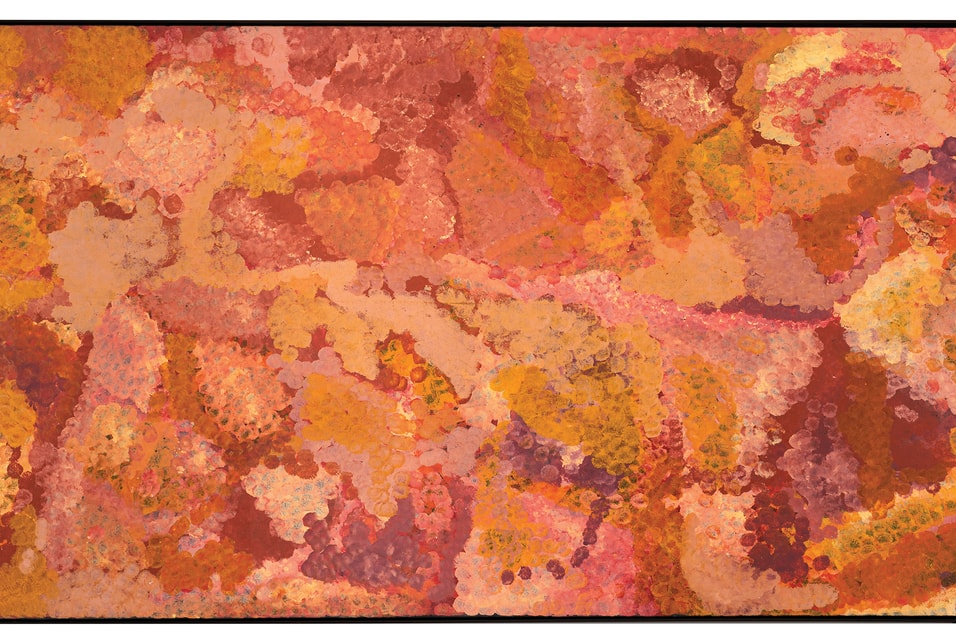
ABU DHABI.- Pace will present a solo booth of paintings by Emily Kam Kngwarray, one of Australia’s most celebrated artists, at the inaugural Frieze Abu Dhabi. The presentation will include a selection of never-before-exhibited paintings alongside works that featured in the gallery’s recent exhibition Emily Kam Kngwarray: The Turning Season held in New York. The works on view span the artist’s entire career, from her early batik textiles and paintings through to her later colorist canvases and abstractions inspired by the anwerlarr yam.
A member of the Anmatyerr people of Alhalker in Australia’s Northern Territory, Kngwarray grounded her practice in Indigenous Australian knowledge systems and a profound custodial connection to ancestral lands. Her expansive worldview encompassed the histories, relationships, topography, and plant life of the surrounding environment. Working in the remote Central Desert community then known as Utopia, she drew deeply on Anmatyerr spirituality, cultural traditions, and the landscape that shaped her life. Kngwarray’s paintings, characterized by layered brushstrokes and dabs of paint, embody the vibrancy and rhythm of the natural world, reflecting her acute sense of its dynamic and pulsating nature. Centered on imagery from her homeland, the artist often portrayed root systems and life cycles of plants.
Kngwarray drew much of her creativity from The Dreaming—a cultural worldview and comprehensive framework that structures and narrates relationships among individuals, families, ancestral history, future descendants, and the land and spirits. Her artistic journey was shaped by her role in ceremonial traditions, expressed through dance, chant, and the painting of bodies with natural materials such as ground ochre, charcoal, and ash. As an Elder of the Anmatyerr people and a custodian of sacred land, she developed a complex and potent visual language, which translated across her vibrant batiks and later paintings on canvas that brought her international acclaim.
Kngwarray first worked in batik, an Indonesian textile dyeing technique introduced to a group of Alyawarr and Anmatyerr women from the Utopia region in the Northern Territory in 1977. Kngwarray was an original member of the Utopia Women's Batik Group, and she made unique experimentations and developed her own personal style in works such as the untitled batik on silk from 1981 on view in Pace’s presentation. By the late 1980s, when she was in her 70s, she transitioned to painting on canvases.
“I did batik at first, and then after doing that I learned more and more and then I changed over to painting for good,” Kngwarray said. “I didn’t want to continue with the hard work batik required—boiling the fabric over and over, lighting fires, and using up all the soap powder over and over. That’s why I gave up batik and changed over to canvas—it was easier. My eyesight deteriorated as I got older, and that’s another reason I gave up batik on silk. It was better for me to just paint.”
The anwerlarr, or pencil yam, and its interconnected life above and below ground remained a lasting source of inspiration for Kngwarray’s abstract paintings. In paintings such as Desert Tracks (1992), featured on Pace’s booth, she represented these forms in compositions overlaid with fields of singular and concentric double dots, developed through a highly gestural and physically engaged process. Describing the yam’s deep connection to both her Country and herself, she said, “I paint my plant, the one I am named after—those seeds I am named after. Kam is its name. . . . The pencil yam grows in our Country—it belongs to us—the anwerlarr yam. They are found growing up along the creek banks. That’s what I painted. I keep on painting the place that belongs to me—I never change from painting that place.”
Over the years, Kngwarray continued to develop her visual language, embracing new experimentations with color and bold, linear forms in paintings like Anatye - Bush Potato (1995). Jennifer Green writes, “As her painting style changed, Kngwarray obscured the palimpsest of linear elements with dots. Then, in another shift in style, she painted more austere works of bold, often monochromatic, linear gesture-black on white, or white on black.” The artist continued refining her lyrical compositions until her passing in 1996.
Coinciding with Pace’s presentation, Kngwarray’s oeuvre will feature in a talk organized by Frieze on curating across knowledge systems. Kelli Cole, curator of Kngwarray’s major solo exhibitions at the National Gallery of Australia and the Tate Modern, London, will present on the artist’s practice in discussion with Claudia Segura and Cosmin Costinas.
Emily Kam Kngwarray (b. ca. 1914, Alhalker, Utopia, Australia; d. 1996, Mparntwe/Alice Springs, Australia) was a prolific artist, executing an estimated three thousand paintings in an eight-year span. In 1997, she was represented posthumously at the 47th Venice Biennale. Her work is held in public collections worldwide, including Araluen Arts Centre, Alice Springs, Australia; Lowe Art Museum, University of Miami, Coral Gables, Florida; Museum of Contemporary Art Australia, Sydney; National Gallery of Victoria, Melbourne; and The Vatican Museums, Vatican City, among many others. In 2025, Kngwarray was the subject of a solo exhibition at Pace’s London gallery, organized with the support of D’Lan Contemporary. This was followed by a major exhibition at the Tate Modern, London (2025–26), which traveled to Fondation Opale, Lens, Switzerland, where it will remain on view through November 8, 2026.
 Crespo Foundation presents 'Aftergrowth' featuring Glenkeen Garden artists in Frankfurt
 WWII guns of utmost precision are on the front lines for a weekend of intense bidding battles
 WWII guns of utmost precision are on the front lines for a weekend of intense bidding battles, Oct. 24-25 at Milestone’s Premier Firearms Auction
 Pulitzer Arts Foundation presents Olga de Amaral: Weaving the Infinite