GRAZ.- The nature of space lies at the heart of some of the most fundamental questions in philosophy and physics. How space is conceived, perceived and experienced is also a subject explored by many cultural theories. Whatever the approach, it remains a phenomenon that both fascinates and challenges us. These different perspectives form the starting point for Eva Schlegel’s artistic practice. For some time now, she has been examining how perception and immateriality shape our relationship with space. Working across sculpture, photography, video, image objects and augmented reality, she creates moments of disorientation and reorientiation, transforming them into spatial experiences. Blurring, reflection and materiality are for her a way of breaking down familiar patterns of perception and challenging the seemingly fixed boundaries of space.
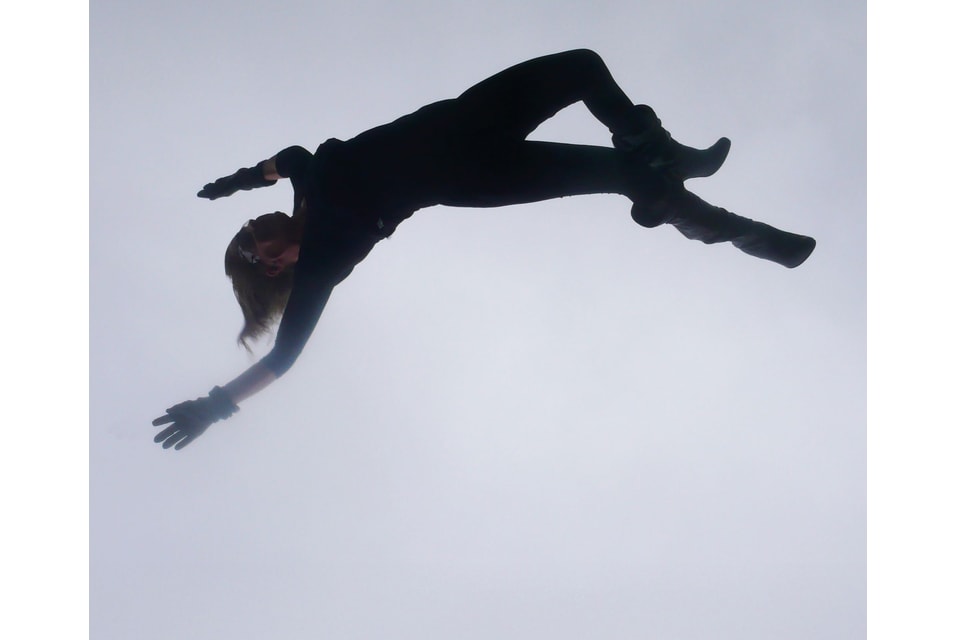
As we are faced with far-reaching global crises, one of the defining experiences of our time is a loss of orientation. The exhibition Falling up responds to this feeling and counters it by offering a different perspective. The paradoxical title defies the laws of gravity while opening up the possibility of understanding disorientation as a shift in our perspective, rather than just a threat.
At the very start of the exhibition, we encounter this field of tension as a slowly rotating mirror sculpture, Floating Orbit. Its highly polished steel rings fragment the space even as they appear to expand it, without offering the viewer the familiar image of their own reflection. Rather than self-assurance, they produce a sense of confusion. A seating object designed especially for the Kunsthaus Graz continues this engagement with the dissolution of space. The mirrored, cloudlike seating installation causes architecture, artworks and visitors to merge into one another, evoking a sense of boundlessness and suspension.
The video works in the exhibition also introduce a shift in perception. For see the invisible, the distinctive window opening of Space01 is transformed into the porthole of a spaceship. Affectionately dubbed the ‘Nasty Nozzle’ by the Kunsthaus architect Peter Cook, the opening would usually frame a view of the Graz clocktower. Here it becomes a window onto the universe, allowing us to explore the cosmos with scientific precision and imagination. In in between, quotations from astronauts alongside footage of floating bodies are shown across two huge rotors. As the projection surfaces rotate, the images and letters appear to float, creating a link between visual movement and the motifs of weightlessness.

The use of blurring is another key stylistic element in Eva Schlegel’s work. In the series Liminal Spaces, the blurred architectural forms suggest transitional states rather than identifiable places. These are interstitial spaces that exist neither here nor there; they raise questions about belonging, about orientation and perception. The principle of blurring is also employed in Schlegel’s works with mirrors and texts, where familiar assumptions about visibility are deliberately disrupted.
The abstract video work dance of chance is based on Alan Turing’s theory of biological pattern formation. Here, forms and structures emerge from apparently random processes. As its title suggests, Schlegel conceives of change not as a disruption, but rather as a productive force and the necessary condition for the creation of new orders. In this sense, the work embodies Eva Schlegel’s fundamental interest in transitional states.
At its literal endpoint, the exhibition culminates in the monumental installation bubbles, made up of weather balloons that block the usual route, forcing visitors to change direction. Both vast and fragile, this barrier makes the loss of familiar orientation into a physical experience, while also alluding the balloons’ intended purpose: the exploration of the invisible phenomena of our atmosphere.
Falling up encourages us to think of space as something dynamic and subjective. Eva Schlegel demonstrates how perception can make us feel as though we are falling up, even while gravity constantly binds us to the Earth. Indeed, it is precisely this loss of familiar orientation that opens up the possibility of rediscovering space and our own physical position within it.
Eva Schlegel (*1960 in Hall in Tirol, live and works in Vienna), awarded the Austrian Decoration for Science and Art, she is considered one of the leading voices in contemporary Austrian art. Her international recognition is also reflected in her involvement at the Venice Biennale: in 1995 she represented Austria with her own work, and in 2011 she curated the Austrian pavilion, which showed an installation by Markus Schinwald. From 1997 to 2006 she taught at the Academy of Fine Arts in Vienna, sharing her engagement with perception and space with students.
 Modernism, San Francisco opens first posthumous survey of James Hayward
 Cosmologies and deep time collide in Andrius Arutiunian and Saodat Ismailova exhibition
 'Stonewall' Jackson Harpers Ferry flag leads Heritage's Nov. 11-12 Political Americana Auction
 People, place and the power of tradition meet in two November auctions at Heritage