

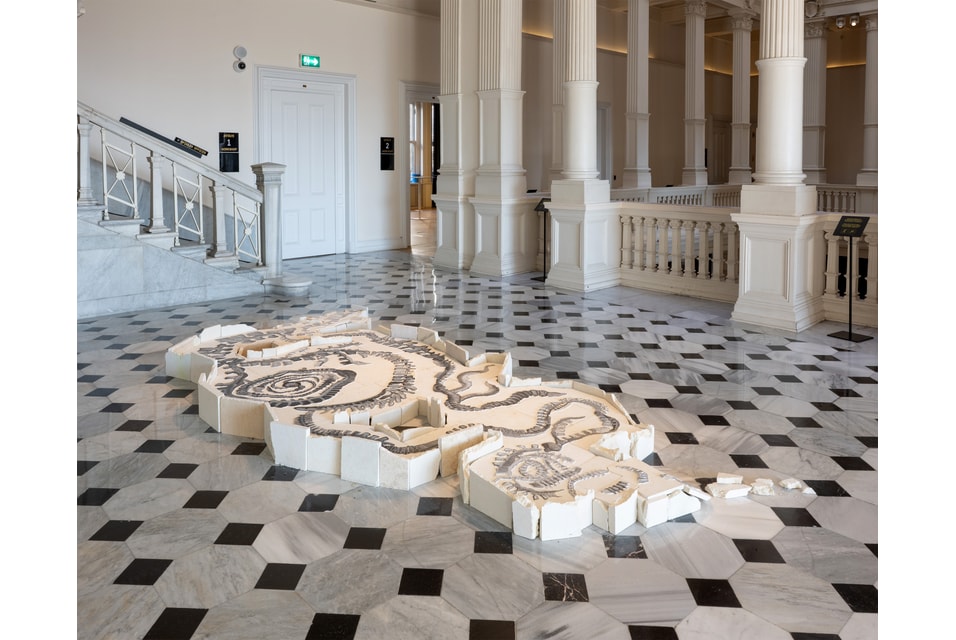
ISTANBUL.- Workplaces are among the most central yet least visible spaces of everyday life. They often remain outside the public eye as closed spaces to which there is “no admittance except on business.”
Once a symbol of industrial capitalism with its chimneys rising above city centers, the factory largely lost its urban visibility after 1980, as production was reorganized on a global scale. As manufacturing facilities in city centers gave way to residential projects, shopping centers, and cultural venues, production moved to the outskirts of cities, Organized Industrial Zones, and new infrastructural geographies where logistics networks converge. Yet spaces of production extend beyond the physical boundaries of the factory; they transform the earth, everyday life, and digital space into a continuous field of work.
Founded by Garanti BBVA, Salt’s new exhibition No Admittance Except on Business suggests reading production across different scales: the worker’s body, the “workplace” where the labor-capital relationship is constituted, the urban space, and global networks of circulation. Focusing on the optimization of the body and labor and their subjection to automation, Merve Bedir explores the relationship between humans, machines, and space. Kamil Dalkır and Sibel Karadağ examine recycling sites in Istanbul within the context of the global waste economy and trace the physical toll on workers who process waste imported from Europe. belit sağ’s work centers on the privatization and liquidation of the Sümerbank Bakırköy Cloth Factory, drawing a connection between the neoliberal discourse that views public factories as a “burden” on the state and the damage inflicted on workers’ bodies by harsh working conditions.

Dilşad Aladağ examines the transformation of the Simyonoğlu Factoryfirst into the National Factory and later into a museumthrough the tensions between official archives, social narratives, and personal memory. The archive created by Metehan Özcan from found materials, including job postings and factory yearbooks, opens up questions around the distinctions between private and public, and between industrial production and social reproduction, in modernist work and residential spaces.
The exhibition positions the factory not only as a space of discipline and control, but also as a space where creative resistance can emerge. Sultan Gökdemir documents how the workers’ protests across Turkey in 1989 transformed the city into a space of collective dissent. Tamar Levit and Yaën S. Levi, in collaboration with Neval Tarım and the Çalışan Eller [Toiling Hands] choir, address the struggle for the rights of textile workers producing for global supply chains.
No Admittance Except on Business presents a multilayered narrative that spans workplaces hidden behind closed doors, everyday practices, forms of solidarity and resistance, factory stories pushed to the margins, and the fractures in memory. The exhibition is on view until February 14, 2027, in the Mastercard Exhibition Hall and on the ground and first floors of Salt Galata.
In parallel with the exhibition, Out of the archive: Industrial Architecture in Turkey, prepared by Orkun Dayıoğlu from Salt, can be viewed on the third floor of Salt Galata from October 20. Compiled from various archives at Salt Research, the presentation focuses on a selection of factories designed by architects active in 20th-century Turkey, including Vasil Vingas, Doğan Tekeli, Sami Sisa, Aydın Boysan, Cengiz Bektaş, and Şevki Pekin. These buildings offer insights into the history of architecture and engineering in Turkey, as well as the social dynamics and work culture of the era.

 The ICA at VCU presents Tony Cokes, Cassi Namoda, and Diane Severin Nguyen
 Fifty artists examine the unfamiliar in new collection survey at Espoo Museum of Modern Art
 $25M real gemstone Marvel Infinity Gauntlet going to auction for first time
 The Cleveland Museum of Art commissions new site-specific work by Teresita Fernández