SEOUL.- Reproductive labour moves across national borders. Korea, once subjected to colonial rule, now occupies a quasi-imperial position, drawing on resources, labour and care from the Global South. In Yangpyeong in 2018, Minja Gu met Lusi Sapitri, an Indonesian marriage migrant. Sapitri recounted how she had once eaten jajang-myeon (noodles in black bean sauce) without knowing it was made with pork. In her Korean household she is expected to cook Korean food, with pork, as part of her familial duty. She is expected to feed the family, yet has no say in setting the rules of the table.
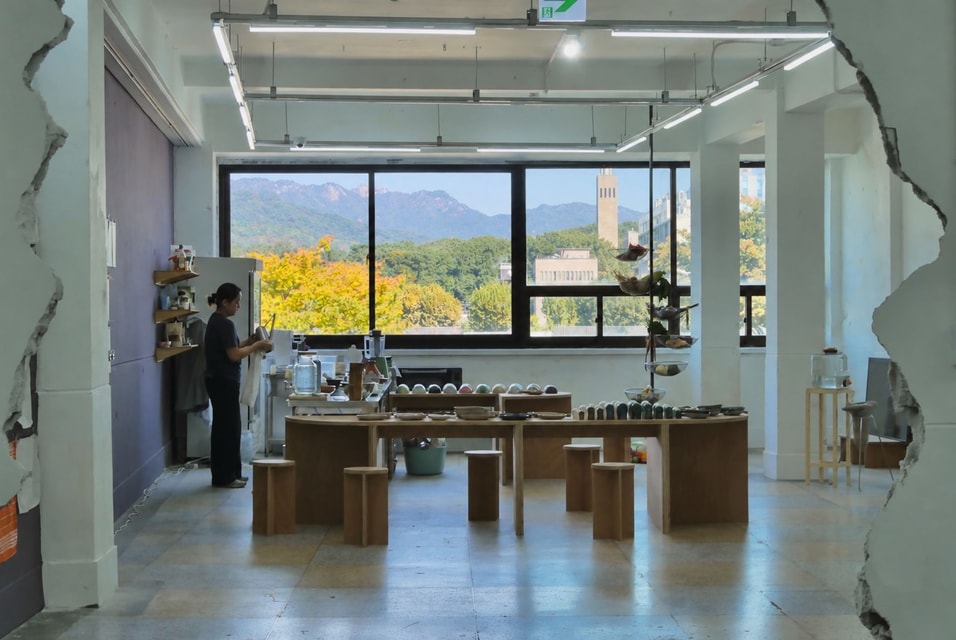
Middle Ground begins with a proposition that reverses this asymmetry. If everyone in the world sat at one table, bringing even taboos they no longer practised, what could they eat together? The exhibition turns the shared meal into an experiment, asking what happens when different dietary rules must all be followed at once. Pork is removed from nettle soup; broth and butter are separated; garlic and scallions, excluded from Buddhist temple cuisine, are omitted, as are the root vegetables prohibited in Jainism. As the list of permissible ingredients dwindles, the different rules can be followed simultaneously. Yet a new conflict emerges when the question shifts from what can be eaten to when eating is permitted. Jain practitioners do not eat after sunset, while Muslims observing Ramadan do not eat during daylight hours. Gu rewrites the conditions again and again, producing new conflicts.
The vessels in the exhibition, resembling a stomach, an oesophagus, a brain, and the Buddha’s toes, evoke one of the most powerful taboos: cannibalism. Even this prohibition has been historically contingent. Today, the human body is transformed into medicinal commodities and as a raw material for cosmetics, pharmaceuticals, and dietary supplements. Each human body is the product of care labor, yet the body that has become raw material has been abstracted from that labour. The taboo of cannibalism forbids eating the body, but it does not forbid consuming the lives of those whose labor made the body.
In To Say “It Can Be Eaten”, the artist’s mother embroidered phrases such as “permitted” and “safe below a certain quantity” onto dishcloths. The hands that once stitched names and affiliations onto her children’s clothes and bags now embroidered statements about what may be eaten, one stitch at a time. In the drawing series What Is Said to Happen to the Body, folk beliefs about pregnancy are written over human figures. The pregnant woman’s body, through which a community reproduces itself, has been the site most densely inscribed with rules governing food.
The exhibition uses kitchen utensils to give physical form to the experiment’s procedures. In A Sifted Order, sieves spiral upwards around a pole. The form of Aristotle’s ladder of nature (scala naturae), a hierarchy of living beings, is recast through the everyday labour of sifting and selecting by hand. In Overlapping Conditions, glass surfaces at different heights are placed atop egg trays, mixing bowls, and drying racks. The ear-shaped ceramic funnels of A Mouth Taught by the Ear filter water for cooking. What everyone shares can also be a source of contamination for some.
Today, the market once again redraws this boundary. Beneath the Ingredient List sifts ingredient lists through a series of dietary restrictions. Four Seasons on Display arranges fresh produce available year-round in supermarkets into four seasonal photographs. In Starting with What We Eat, a three-channel video installed in different parts of the exhibition, people recount how changing beliefs, sensory experiences, and migration have each introduced them to unfamiliar food systems and led them to see their own cultures anew. As Gu puts it, “through eating, we create the world we belong to.” Middle Ground is a site of experimentation that tests the conditions of eating together, while leaving open the question of whether a shared meal is possible at all.
Written by Ji Yoon Yang (Director, Alt Space LOOP)
Translated by eunseo kim (Assistant Curator, Alt Space LOOP)
 The ICA at VCU presents Tony Cokes, Cassi Namoda, and Diane Severin Nguyen
 Fifty artists examine the unfamiliar in new collection survey at Espoo Museum of Modern Art
 $25M real gemstone Marvel Infinity Gauntlet going to auction for first time
 The Cleveland Museum of Art commissions new site-specific work by Teresita Fernández